

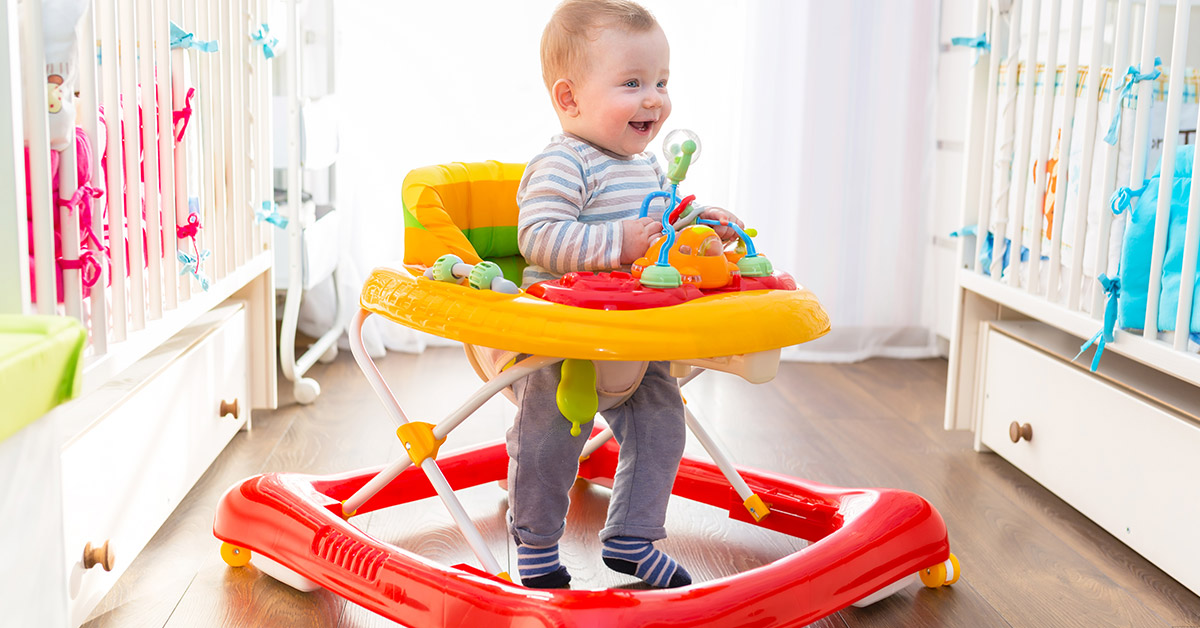
Few baby products carry a bigger gap between what pediatricians recommend and what parents actually buy than the sit-in baby walker. Canada banned the sale, import, and even the resale of baby walkers in 2004, making possession alone punishable by fines. The American Academy of Pediatrics has been calling for a nationwide ban in the United States since 2004 as well. Yet baby walkers remain one of the most popular baby items on the American market, sold at big-box stores, Amazon, and specialty baby retailers to parents who often have no idea that a product on the shelf carries a warning label from the country’s largest pediatric medical organization. Families in Boston, throughout Massachusetts, and across the surrounding New England states should understand both the medical reality of walker injuries and the legal options available when a child is harmed.
This overview walks through why baby walkers cause the kinds of injuries they do, what current safety standards require and where they fall short, how Canada handled the same product differently, and what families can do when a child is hurt. If your child has been injured in a walker-related incident, a personal injury attorney can review the facts of your case and help you understand whether you may have grounds to seek compensation for medical bills, hospital costs, and related losses.
Why Baby Walkers Cause the Injuries They Do
A baby walker gives a child mobility that outpaces their motor development. An infant who cannot yet walk on their own can move across a room in a walker at speeds up to four feet per second. That is faster than most parents can react. A child in a walker can cover the distance between a couch and a stairway, a kitchen counter, a hot stove, or a swimming pool before a caregiver in the same room can stand up. The walker itself is often heavier and taller than the child, which changes how they fall and what they can reach.
Pediatric injury data reflects that mismatch. Head and neck injuries dominate walker-related emergency room visits. Skull fractures, concussions, and traumatic brain injuries from stair falls have been documented for decades. Children in walkers also reach objects that would otherwise be out of range. Coffee mugs on tables, saucepan handles on stoves, dangling appliance cords, cleaning products under sinks, and pool edges in backyards all become accessible in ways they were not before the child got into the walker. The result is a category of injury that includes not just falls but also burns, scald injuries, poisonings, and drownings, all with a walker somewhere in the story.
The Scope of the Problem in Numbers
A landmark study published in the journal Pediatrics found that more than 230,000 children under 15 months old were treated in U.S. emergency departments for walker-related injuries between 1990 and 2014. The majority were under one year old. Skull fractures accounted for a significant share of the more serious cases. At least eight walker-related deaths were reported between 2004 and 2008 in the United States, most involving stair falls.
More recent data shows the numbers have dropped, but not disappeared. Safety standards tightened in 2010 and again in 2022, and walker sales fell by roughly 350,000 units over the last decade. Still, nearly 2,500 walker-related injuries were reported each year between 2021 and 2023. The American Academy of Pediatrics has noted that while stair fall injuries have declined thanks to newer safety features, head and neck injuries remain common, and other risks such as drowning, burns, and poisoning have not been reduced by any current safety standard.
How Canada Handled the Same Product Differently
In 2004, Canada became the first country to ban baby walkers outright. Health Canada made the sale, import, and resale of walkers illegal, including sales at garage sales, flea markets, and through online resale platforms. Possession of a baby walker in Canada can result in fines of up to 100,000 Canadian dollars or six months in jail. Canadian health authorities cited the same body of medical evidence that the American Academy of Pediatrics has been citing for decades.
The United States took a different path. Rather than a ban, U.S. regulators have relied on a series of voluntary and then mandatory safety standards. The Consumer Product Safety Commission issued a final rule in 2010 requiring walkers to include a brake mechanism that stops the walker at the edge of a stair. The standard was updated in 2022 with additional requirements. These changes have reduced some injuries, particularly stair falls, but they have not eliminated the underlying problem. A walker that meets every current federal requirement still allows a pre-walking child to move faster than their reflexes, reach higher than their motor skills, and access hazards in every room of the home.
Consumer Reports asked the CPSC directly in 2024 whether a full ban would be considered. The agency responded that staff continually review incident data and would consider improvements to the mandatory standard as appropriate. That answer stops well short of what the AAP and Health Canada concluded years ago.
How Injuries Happen in Homes That Look Safe
Several patterns show up repeatedly in pediatric case reports. None of them require a careless parent. They involve moments any family creates several times a day.
Stair falls remain the most cited walker injury. A parent installs a baby gate at the top of a staircase and forgets that the child in a walker can also reach the basement door, a step-down between the kitchen and a den, or a raised entry landing. Modern walkers include brake mechanisms designed to stop at a drop-off, but the mechanisms rely on friction and can fail on certain floor surfaces, particularly hardwood, tile, or thick carpet. Older walkers passed down between families or bought secondhand often predate the 2010 standard entirely.
Kitchen burns and scalds show up next. A walker gives a child enough height to reach the handle of a pot on the stove, a cup of coffee on the counter, or the door of a wall oven. Pediatric burn centers regularly treat children who pulled hot liquids onto themselves while parents were cooking. The child’s new reach came from the walker, not from any developmental milestone. Poolside drownings and bathtub incidents follow the same pattern in warmer months and in homes with unfenced water access.
Poisonings and choking incidents happen when children in walkers reach into cabinets, purses, medication organizers, and cleaning supplies. Many households store cleaning products in cabinets that were considered out of reach based on what the child could access on the floor. The walker changes that calculation instantly.
Injuries also happen at second locations. A child who lives in a walker-free home may visit a grandparent, an aunt or uncle, a babysitter, or a daycare provider whose family kept a walker from an older child. Family child care homes in Massachusetts are prohibited from using baby walkers with any child in their care under 102 CMR 8.10, the state’s regulations for family child care programs, but enforcement in home-based care settings is uneven, and gifted or hand-me-down walkers continue to circulate.
In 2004, Canada became the first country to ban baby walkers outright.
Warning Signs That Require Immediate Medical Attention
Any incident involving a walker should prompt a careful medical evaluation, even when a child seems unharmed at first. Head injuries in infants are notoriously difficult to assess visually. Signs that require an immediate trip to the emergency room include:
- Loss of consciousness, even briefly, after a fall
- Persistent crying, unusual irritability, or difficulty being consoled
- Vomiting more than once after a head impact
- Unusual sleepiness, difficulty waking, or a change in normal alertness
- A soft or bulging area on the scalp, or visible swelling that grows over time
- Seizures, unusual eye movements, or unequal pupil size
- Any burn, scald, or exposure to a poisonous substance following a walker incident
Do not assume that a child who seems fine immediately after a fall is uninjured. Skull fractures and intracranial bleeding can develop symptoms over hours or days. If a walker was involved in the incident, preserve it in the condition it was in at the time of the injury. Take photographs of the scene, the walker, and any hazard the child reached. Save receipts, packaging, and any warning labels that came with the product, because these items often become central evidence later if you decide to pursue a claim.
Practical Steps Families Can Take
The clearest step is the one the American Academy of Pediatrics has recommended for decades: do not use a baby walker. Stationary activity centers, which look similar but do not have wheels, provide the same entertainment for a child without the mobility risk. Push toys, which the child moves on their own once they are ready to walk, offer developmental benefits that walkers do not. Multiple pediatric studies have found that walkers can actually delay motor development rather than accelerate it, because they change the way a child engages with their body and their environment.
If a walker is already in the home, remove it entirely. Do not resell it, do not donate it, and do not pass it down. The safest end for a walker is the trash. This same recommendation applies to older walkers from before the 2010 or 2022 standards, which lack modern brake mechanisms and remain in circulation through garage sales, thrift stores, and online marketplaces.
Have a direct conversation with grandparents, babysitters, daycare providers, and any family whose home your child visits. Many caregivers assume that a product sold at a major retailer must be safe for its intended use. A short explanation of what the AAP and Health Canada have concluded often prompts a same-day removal.
Legal Options When a Child Is Injured in a Walker
When a child is hospitalized after a walker-related incident, families often face significant medical costs, including emergency room treatment, neurosurgical care in cases of head injury, follow-up imaging, physical and occupational therapy, and long-term developmental monitoring. Depending on the circumstances, compensation may be available through several legal paths.
Product liability is often the most direct path. Manufacturers, importers, and retailers can be held responsible for design defects, manufacturing defects, or inadequate warnings. Design defect arguments in walker cases can be particularly strong, because the pediatric medical consensus that walkers are unsafe has been publicly available for decades. Failure-to-warn claims often focus on whether the packaging and instructions adequately conveyed the actual risk in a way parents could act on. Warning labels on walkers frequently list a range of hazards in fine print, but pediatric safety researchers have questioned whether those warnings meaningfully influence purchasing or supervision decisions.
Negligence claims may also apply against a daycare facility, family child care provider, after-school program, or family member who used a walker in a home where a child was harmed. In Massachusetts, family child care programs are prohibited from using walkers, and a provider who violated that rule and caused an injury may face additional liability. Premises liability may apply when a child was injured in a walker at a home the family was visiting, particularly when known hazards such as unguarded stairs or accessible pools were present.
Each case turns on the specific facts, including the age of the child, the make and model of the walker, whether it complied with the 2010 or 2022 standard, where it was purchased, and what warnings were present. Massachusetts and each of the surrounding New England states have their own statutes of limitations governing personal injury and product liability claims. Preserving the walker, its packaging, and any medical documentation is critical.
Talk to a Child Injury Lawyer About Your Family’s Case
Baby walker injury cases can be technically complex. They often involve product testing, expert testimony on pediatric development and injury mechanics, review of the applicable federal safety standard, and detailed medical records tracking a child’s recovery. Most families are not in a position to investigate that on their own while also caring for an injured child.
At Swartz & Swartz, P.C., our Boston child injury lawyers can review your case, answer your questions, and offer aggressive representation should you decide to work with us. If your child was injured in a baby walker in Boston, Massachusetts, or the surrounding New England areas, learn more by contacting us online today or calling us at (617) 742-1900 to set up your free case review.
Need Help?
If you or someone you know, needs help from a lawyer, contact the law offices of Swartz & Swartz, use our live chat, or send us a message using the form below and we’ll get in touch to assess your case and how we can help.
About the Author: James Swartz

Keep Reading
Want more? Here are some other blog posts you might be interested in.


A concussion claim in Massachusetts may arise when someone suffers a head injury in a car accident caused by another

Boss harassment in Massachusetts can involve yelling, intimidation, insults, unfair treatment, or other troubling behavior, but not every instance of

After an accident, you may receive a call from an insurance adjuster asking you to explain what happened. The adjuster