

You walk into a grocery store, pharmacy, department store, restaurant, or other business expecting to shop, not leave in an ambulance. But perhaps liquid has been sitting in an aisle. A floor mat has curled upward. A broken step has not been repaired. Merchandise falls from an unstable display. Ice has accumulated near an entrance. Or an employee knows about a dangerous condition but nobody fixes it or warns customers. Then someone gets hurt. If you suffer a store injury in Massachusetts, the fact that the accident happened inside a business does not automatically make the store legally responsible.
But when a business knew or reasonably should have known about a dangerous condition and failed to take reasonable precautions, the circumstances may support a premises liability claim.
The central questions usually involve what made the property dangerous, how the condition developed, whether the store knew or should have known about it, what the store reasonably could have done, and whether that condition caused your injuries.
What Responsibility Does a Massachusetts Store Have to Customers?
Massachusetts premises liability law generally requires property owners and those controlling property to exercise reasonable care toward lawful visitors.
Massachusetts Superior Court model jury instructions explain that a person in control of property has a duty to use reasonable care to maintain the property in a reasonably safe condition, considering the circumstances. The duty can also involve warning lawful visitors about dangerous conditions when appropriate.
For a retail store, that can mean taking reasonable steps to identify and address hazards customers may encounter.
It does not mean a store must prevent every conceivable accident.
The question is whether the business acted reasonably under the circumstances.
What Is Considered a Dangerous Condition in a Store?
Dangerous conditions can take many forms.
Common examples include:
- spilled liquids or food on floors;
- wet entrance areas;
- broken or uneven flooring;
- loose rugs or mats;
- defective stairs or handrails;
- poorly maintained parking lots;
- ice or snow;
- inadequate lighting;
- merchandise stacked unsafely;
- objects obstructing walkways;
- damaged shelving; or
- debris left where customers walk.
Not every condition automatically amounts to negligence.
A claim requires examining the circumstances surrounding the hazard and accident.
For example, a spill that occurred seconds before someone fell presents different questions from a leaking refrigerator that employees had been walking past for hours.
What if the Store Already Knew About the Dangerous Condition?
This can be an important part of a premises liability case.
Imagine an employee notices water leaking from a refrigerator onto the floor.
Customers also complain about it.
An employee places a bucket nearby but does not clean the surrounding floor, block the area, or provide an adequate warning.
Later, a customer slips in the water and suffers a serious injury.
Evidence showing that employees knew about the hazard before the accident could become highly relevant.
Actual knowledge might be established through employee testimony, incident reports, maintenance records, customer complaints, surveillance footage, emails, or other evidence.
But actual knowledge is not always the only issue.
What if Nobody Told the Store About the Hazard?
A store may potentially face liability even when nobody can prove an employee personally saw the exact hazard before the accident.
Massachusetts premises liability law examines reasonable care under the circumstances.
The issue may include whether the dangerous condition existed long enough that reasonable inspection or maintenance practices should have discovered it.
Consider two situations.
In the first, another customer drops a bottle of water and you slip on it almost immediately.
In the second, water has been accumulating in the same aisle for an extended period while employees repeatedly walk nearby.
Those situations can raise very different questions about what the store reasonably should have known and done.
Massachusetts Also Recognizes the “Mode of Operation” Approach
Some store accidents involve another important concept.
Massachusetts courts have recognized a “mode of operation” approach in certain premises liability cases. Under this doctrine, the focus can shift when a business’s chosen method of operation makes it reasonably foreseeable that dangerous conditions will regularly occur.
Massachusetts Superior Court jury instructions specifically discuss this principle and cite the Massachusetts Supreme Judicial Court’s decision in Sheehan v. Roche Bros. Supermarkets, Inc.
This can be particularly relevant in self-service environments.
Imagine customers selecting loose produce, serving themselves food, carrying beverages, or handling merchandise without employee assistance.
If the nature of the operation makes spills or similar hazards reasonably foreseeable, the legal analysis may differ from a situation involving an isolated hazard unrelated to how the business operates.
That does not mean every accident at a self-service store establishes liability. The circumstances still matter.
Does a Store Have to Warn You About a Hazard?
Sometimes a reasonable warning can be important.
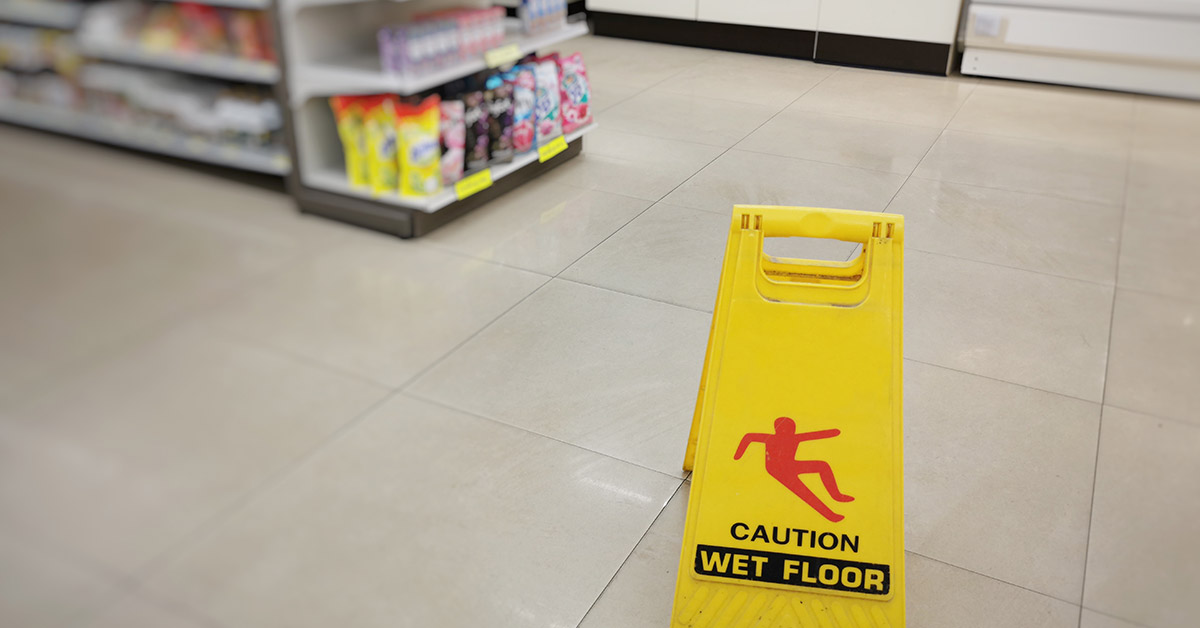
For example, if a floor has just been mopped, a visible wet-floor sign may help alert customers.
But merely placing a sign somewhere in the general area does not necessarily resolve every question.
You would want to know:
Where was the sign?
Could customers see it before encountering the hazard?
Was the warning specific enough?
Was the dangerous area blocked?
Could the store reasonably have eliminated the danger instead?
Massachusetts jury instructions explain that whether a warning was required and whether a warning was sufficient can depend on the circumstances.
What if the Dangerous Condition Was Obvious?
Businesses may argue that a customer should have noticed an obvious hazard.
Massachusetts law recognizes that an owner or person controlling property generally does not have a duty to warn lawful visitors about an open and obvious danger because the danger itself may provide sufficient warning.
But that does not necessarily end the analysis.
Massachusetts Superior Court jury instructions explain that a property owner may still have a duty to remedy an open and obvious danger when the owner can and should anticipate that it may cause physical harm despite being obvious. That can include circumstances where distraction or other foreseeable factors make an injury possible.
So a store cannot necessarily defend every case simply by arguing, “You should have seen it.”
The entire situation matters.
If the nature of the operation makes spills or similar hazards reasonably foreseeable, the legal analysis may differ from a situation involving an isolated hazard unrelated to how the business operates.
What if You Were Looking at Merchandise When You Fell?
Retail stores are specifically designed to attract customers’ attention.
Signs, displays, shelves, pricing, advertisements, other shoppers, and merchandise compete for attention.
If a customer fails to notice a floor hazard while looking at merchandise, that does not automatically establish that the customer was responsible for the accident.
The circumstances need to be evaluated.
Where was the hazard?
Was it difficult to see?
Was lighting poor?
Was the customer expected to look toward merchandise?
Was there an adequate warning?
How long had the condition existed?
These facts can all become relevant.
What Can Cause a Store Injury in Massachusetts?
A slip or fall is one of the most common situations that can lead to a store injury in Massachusetts. However, proving that the business was responsible still requires evidence about what caused the accident and what the store knew or reasonably should have known.
The source of the liquid matters.
Was a freezer leaking?
Had an employee just mopped?
Did another customer spill a drink?
Was rainwater repeatedly being tracked through the entrance?
Were employees aware of the condition?
Did the store have inspection procedures?
How long had the liquid been there?
Was there a warning?
Evidence answering these questions can become extremely important.
Slip-and-fall accidents are among the most familiar examples of a store injury in Massachusetts, but proving liability can still be complicated. Premises liability is one of several types of personal injury claims, and each type of case can require different evidence and legal analysis. Swartz & Swartz explains these differences in Do Personal Injury Lawyers Work on All Types of Cases?.
What if Merchandise Falls and Hits You?
Not every retail injury involves a fall.
Customers can also be injured when merchandise, shelving, signs, or displays fall.
Imagine heavy merchandise stacked high above customers.
If the display is unstable and an item falls, the investigation may look at how merchandise was stored, whether the display complied with store procedures, whether employees had previously noticed problems, and whether similar incidents occurred.
Surveillance video can be particularly important in these situations.
So can photographs taken immediately after the accident.
What if You Are Hurt in a Store Parking Lot?
Premises liability does not necessarily stop at the front door.
Depending on who owns, controls, or maintains the area, injuries occurring in parking lots, sidewalks, entrances, and other exterior areas can raise premises liability questions.
Hazards might include:
potholes;
broken pavement;
poor lighting;
snow or ice;
defective curbs;
or unsafe walking surfaces.
Determining responsibility can become more complicated when the store leases space in a larger shopping center.
The store, property owner, property management company, maintenance contractor, snow-removal company, or another entity may have responsibilities depending on the circumstances and contractual arrangements.
Identifying who actually controlled the dangerous area can therefore be an important part of the investigation.
What if You Fall on Snow or Ice Outside a Store?
Massachusetts winters create another category of premises liability cases.
Snow and ice accidents require careful factual analysis, including weather conditions, property maintenance, timing, control of the area, and what reasonable precautions were taken.
Massachusetts law also contains specific notice provisions that may apply to certain claims involving injuries caused by snow or ice conditions on premises or adjoining ways.
Because deadlines and notice requirements can affect legal rights, an injured person should avoid assuming that every premises liability deadline is identical.
What Should You Do Immediately After Getting Hurt in a Store?
The steps you take immediately after a store injury in Massachusetts can also affect the evidence available later.
Your health comes first.
If you need emergency medical care, get it.
When your condition permits, there are also practical steps that can help preserve information about what happened.
Report the accident to a manager or employee.
Ask that an incident report be created.
Take photographs or video of the dangerous condition before it is cleaned, repaired, moved, or removed.
Photograph the surrounding area as well.
Get contact information from witnesses.
Keep the shoes and clothing you were wearing.
Write down what happened while the details are fresh.
And seek appropriate medical evaluation for your injuries.
Do not exaggerate what happened, but do not minimize it either.
Take Pictures Before the Condition Disappears
Photographs taken immediately after a store injury in Massachusetts can preserve details that may disappear within minutes.
This is particularly important in retail injury cases.
A spill can be cleaned in minutes.
A mat can be repositioned.
Broken merchandise can be removed.
Ice can melt.
A display can be rebuilt.
By the time you return to the store, the condition may look completely different.
If you can safely take photographs immediately after the accident, capture both close-up and wider images.
A close-up might show the water itself.
A wider photograph can show whether there were warning signs, how the aisle was configured, the lighting, and where the hazard was in relation to the customer’s path.
Ask the Store to Preserve Surveillance Video
Many retail stores use security cameras.
Video may show:
when the dangerous condition appeared;
whether employees walked past it;
whether customers complained;
how long it remained;
whether warning signs were present;
and exactly how the accident occurred.
But surveillance recordings may not necessarily be preserved indefinitely.
An attorney investigating a premises liability claim may send a preservation request asking the business to retain relevant footage and other evidence.
That is one reason why waiting too long after a serious store accident can make an investigation more difficult.
Store Records Can Also Be Important
Surveillance video is only one potential source of evidence.
A premises liability investigation might also involve:
incident reports;
inspection logs;
cleaning records;
maintenance records;
employee schedules;
prior complaints;
photographs;
witness statements;
training materials;
and records concerning previous accidents.
The exact evidence depends on what happened.
If the claim involves a leaking freezer, maintenance records may matter.
If merchandise fell, store display procedures may matter.
If a customer slipped in an aisle, inspection and cleaning records may become important.
How Do You Prove a Store Injury in Massachusetts?
Proving a store injury in Massachusetts claim requires more than showing that an accident happened inside a business.
The evidence may need to establish that the defendant owed you a duty of reasonable care, failed to meet that duty, and that the failure caused your injury and resulting losses.
Massachusetts jury instructions direct jurors to consider whether, under all the circumstances, an ordinarily prudent person in the defendant’s position would have taken preventive steps that the defendant did not take.
That is why the details surrounding the dangerous condition are so important.
A serious injury alone does not establish negligence.
Likewise, a dangerous condition alone does not necessarily prove that the business was legally responsible for an accident.
The pieces have to connect.
Can the Store Blame You for the Accident?
It may try.
A store or its insurer might argue that you were not paying attention, ignored a warning, wore inappropriate footwear, entered an area that was blocked off, or otherwise contributed to the accident.
That does not necessarily mean you cannot pursue a claim.
Massachusetts follows a modified comparative negligence system. Under Massachusetts General Laws Chapter 231, Section 85, contributory negligence does not bar recovery when the injured person’s negligence is not greater than the total negligence attributable to the person or persons against whom recovery is sought. Any damages are reduced in proportion to the injured person’s share of negligence.
The allocation of fault depends on the evidence.
What Injuries Can Dangerous Store Conditions Cause?
Store accidents can cause much more than temporary soreness.
Depending on the accident, injuries can include fractures, ligament injuries, back injuries, neck injuries, head trauma, traumatic brain injuries, cuts, shoulder injuries, knee injuries, spinal injuries, and other serious harm.
Older adults can be particularly vulnerable to serious consequences from falls.
Some injuries also become more significant over time.
A person may initially believe they are simply bruised, only to discover later that they suffered a fracture, torn ligament, concussion, or other injury requiring ongoing treatment.
That is another reason to seek appropriate medical attention after a significant accident.
Compensation After a Store Injury in Massachusetts
Compensation following a store injury in Massachusetts depends on the severity of the injuries, the available evidence, and the losses caused by the accident.
The damages available depend on the individual circumstances.
A premises liability claim may potentially involve compensation for losses such as reasonable medical expenses, lost earnings, diminished earning capacity, and pain and suffering when supported by the evidence and applicable law.
For someone who suffers a serious injury, the consequences may extend far beyond the initial emergency room visit.
There may be physical therapy, surgery, time away from work, future medical treatment, chronic pain, or limitations on everyday activities.
The value of a claim cannot responsibly be determined from the type of accident alone.
The evidence concerning liability, injury severity, treatment, prognosis, economic losses, insurance coverage, and other circumstances all matter.
What if the Store’s Insurance Company Calls You?
Be careful about assuming the insurer is simply trying to help determine what happened.
The insurance company represents its insured’s financial interests.
You may be asked for a recorded statement, medical authorization, or information about the accident and your injuries.
You should be truthful, but you do not need to speculate.
For a significant injury, you may want to understand your rights before providing extensive statements or signing documents.
Likewise, do not rush to accept an early settlement simply because the insurer makes an offer.
The full impact of an injury may not yet be known.
How Long Do You Have to Bring a Claim?
Deadlines matter in Massachusetts personal injury cases.
The applicable deadline can depend on the type of defendant, accident, and legal theory involved. Certain cases may also involve additional notice requirements.
For example, as noted above, Massachusetts has specific notice provisions concerning some claims arising from snow and ice conditions.
That is another reason not to wait until evidence has disappeared or a deadline is approaching before investigating a serious injury.
When Should You Speak With a Premises Liability Lawyer?
If a store injury in Massachusetts causes serious or lasting harm, getting legal guidance early can also help preserve evidence that may otherwise disappear.
Not every fall inside a store requires an attorney.
But speaking with a lawyer may be particularly useful when:
the injury is serious;
the dangerous condition had apparently existed for some time;
employees knew about the hazard;
there had been previous complaints;
the store disputes what happened;
surveillance footage may exist;
the insurance company is blaming you;
or the accident has resulted in substantial medical bills, lost income, or long-term limitations.
Swartz & Swartz handles cases involving unsafe properties through its Inadequate Security and Premises Liability Litigation practice. The firm represents injured people and families in Boston and throughout Massachusetts.
Frequently Asked Questions About Store Injuries in Massachusetts
Can I sue a store if I slip and fall in Massachusetts?
Potentially. The fact that you fell inside a store is not enough by itself. The circumstances surrounding the dangerous condition, the store’s conduct, causation, and your injuries all matter.
Does the store have to know about the spill before it can be responsible?
Not necessarily in every case. Actual knowledge can be important, but Massachusetts premises liability law can also involve what the store reasonably should have discovered or anticipated. Certain self-service circumstances may also implicate Massachusetts’s mode-of-operation doctrine.
What if there was a wet-floor sign?
A warning sign can be important evidence, but it does not automatically decide every case. Its location, visibility, adequacy, and the nature of the danger all matter.
What if the hazard was obvious?
An open and obvious condition can affect the duty to warn. However, Massachusetts jury instructions recognize circumstances where a duty to remedy an obvious danger may remain if harm should still reasonably be anticipated.
Should I report my accident to the store?
Yes. If your condition allows, report the incident to a manager and ask that it be documented. Keep your own record of who you spoke with and what was said.
Should I take pictures after a store accident?
If you can safely do so, photographs can be extremely useful because temporary hazards such as spills, debris, snow, or misplaced objects may disappear quickly.
Can surveillance footage help prove my claim?
Potentially. Video may show how the hazard developed, how long it existed, what employees did, whether warnings were present, and how the accident occurred.
What if I was partly responsible for falling?
Partial responsibility does not necessarily eliminate a Massachusetts negligence claim. Massachusetts comparative negligence rules can reduce damages based on a plaintiff’s share of fault and can bar recovery if the plaintiff’s negligence exceeds the combined negligence attributed to the defendant or defendants.
When a Store Ignores a Dangerous Condition, Evidence Matters
Every store injury in Massachusetts is different, which is why the condition of the property, the store’s knowledge, and the available evidence all matter.
So, what happens if a store ignores a dangerous condition and you get hurt?
The answer depends on more than where the accident happened.
A strong investigation asks:
What was dangerous?
Who controlled the property?
How long had the hazard existed?
Did employees know about it?
Should reasonable inspection or maintenance have discovered it?
Was there a warning?
Could the condition reasonably have been corrected?
Did that condition cause the injury?
And what losses resulted?
Those questions can be answered through photographs, surveillance footage, incident reports, witnesses, maintenance records, medical documentation, and other evidence.
If a dangerous condition in a store causes a serious injury, determining responsibility may require examining how the property was maintained, what the business knew, and what evidence remains available. Swartz & Swartz handles unsafe-property cases through its premises liability practice.
Need Help?
If you or someone you know, needs help from a lawyer, contact the law offices of Swartz & Swartz, use our live chat, or send us a message using the form below and we’ll get in touch to assess your case and how we can help.
About the Author: James Swartz

Keep Reading
Want more? Here are some other blog posts you might be interested in.

You walk into a grocery store, pharmacy, department store, restaurant, or other business expecting to shop, not leave in an

You complain to HR because something at work feels wrong. Maybe a supervisor is making discriminatory comments. Maybe a coworker is

After a serious injury, some losses are easy to put on paper. A hospital bill has a number. A paycheck you missed