

A sidewalk injury in Massachusetts can happen in an instant. You may be walking to work, leaving a restaurant, visiting a neighborhood business, or taking an ordinary afternoon walk when your foot catches on raised concrete, a broken pavement slab, or a deep crack. Before you realize what happened, you are on the ground with a painful injury.
A fall on a damaged sidewalk can cause more than embarrassment or temporary soreness. Broken wrists, hip fractures, knee injuries, concussions, and other serious conditions may require medical treatment, time away from work, and months of recovery.
Yes, you may be able to sue if you fall on a broken sidewalk in Massachusetts. However, the right to recover compensation depends on who was legally responsible for the sidewalk, whether the dangerous condition could reasonably have been addressed, and whether the applicable legal requirements are satisfied.
When the sidewalk is part of a public way, Massachusetts law imposes special rules that can make these claims substantially different from ordinary premises liability lawsuits.
Understanding those differences is especially important because some sidewalk injury claims require written notice within just 30 days.
Who Is Responsible for a Broken Sidewalk in Massachusetts?
The first question after a sidewalk accident is often who was responsible for maintaining the location where the fall occurred.
That answer is not always obvious.
A sidewalk may run directly in front of a private residence, restaurant, apartment building, or retail store. However, the fact that a sidewalk borders private property does not automatically mean the adjoining property owner is legally responsible for its structural condition.
Many sidewalks are part of public ways maintained by a city, town, or another governmental authority.
Other pedestrian walkways may be privately owned or controlled.
For example, a walkway leading from a private parking lot to a shopping center may fall under different legal rules than a municipal sidewalk along a Boston street.
Determining responsibility may require examining property records, municipal maintenance obligations, the location of the defect, and whether a private party created or contributed to the hazard.
An experienced attorney can investigate these questions before deciding whom to pursue for compensation.
Can You Sue the City of Boston for a Sidewalk Injury?
Potentially, yes.
Massachusetts General Laws Chapter 84, Section 15 allows certain claims against municipalities and other parties legally obligated to repair public ways when an actionable defect causes injury.
However, municipal sidewalk claims are subject to requirements that differ from ordinary negligence lawsuits.
The injured person generally must establish that the defect caused the injury and that the responsible public entity had, or through reasonable care could have had, notice of the condition.
The condition must also meet the legal requirements for a defective public way.
A municipality is not automatically liable simply because a sidewalk was cracked or uneven.
For example, if a sidewalk slab had been significantly raised for an extended period, the circumstances might support an argument that the municipality should have discovered and addressed the hazard.
By contrast, a newly created condition that the municipality had no reasonable opportunity to identify may present a more difficult claim.
The exact location, condition, maintenance history, and available evidence matter.
How Long Do You Have to Report a Sidewalk Injury in Massachusetts?
For many public-way defect claims, Massachusetts General Laws Chapter 84, Section 18 requires the injured person to provide written notice within 30 days of the injury to the public entity or other party legally obligated to maintain the way.
This is one of the most important distinctions between public sidewalk cases and ordinary personal injury claims.
The written notice generally must identify the injured person and provide required information about the time, location, and cause of the injury.
Specific statutory requirements govern the notice and how it must be delivered.
A phone call to a city department, an online complaint about a broken sidewalk, or a police report should not automatically be assumed to satisfy the legal notice requirement.
The correct recipient also matters. A sidewalk maintained by a city may involve a different responsible authority from one maintained by the Commonwealth or another governmental body.
The Massachusetts Trial Court Law Libraries explain these rules in their official resource on Massachusetts law about potholes and road defects.
Because missing a required notice deadline can jeopardize a claim, an injured person should seek legal guidance promptly rather than assuming there is plenty of time.
Is the Deadline Different for a Sidewalk Injury on Private Property?
It can be.
A fall on a privately controlled walkway may be governed by ordinary premises liability principles rather than the public-way defect statute.
For example, someone who falls on a broken walkway inside a privately owned shopping center may have a claim against a property owner, occupier, or another responsible party.
Massachusetts generally provides a three-year statute of limitations for negligence-based personal injury lawsuits under Chapter 260, Section 2A.
However, that does not mean every sidewalk injury has a three-year period without additional requirements.
The governing law depends on the location, responsible party, and legal basis of the claim.
Massachusetts courts have also recognized that certain private parties who negligently create defects in public ways may be sued under ordinary negligence principles without the same Chapter 84 notice requirement imposed on public authorities.
Because several legal theories may be involved, determining who created or controlled the hazard can be essential.
What Counts as a Dangerous Sidewalk Defect?
A sidewalk defect may involve a physical condition that makes ordinary pedestrian travel unsafe.
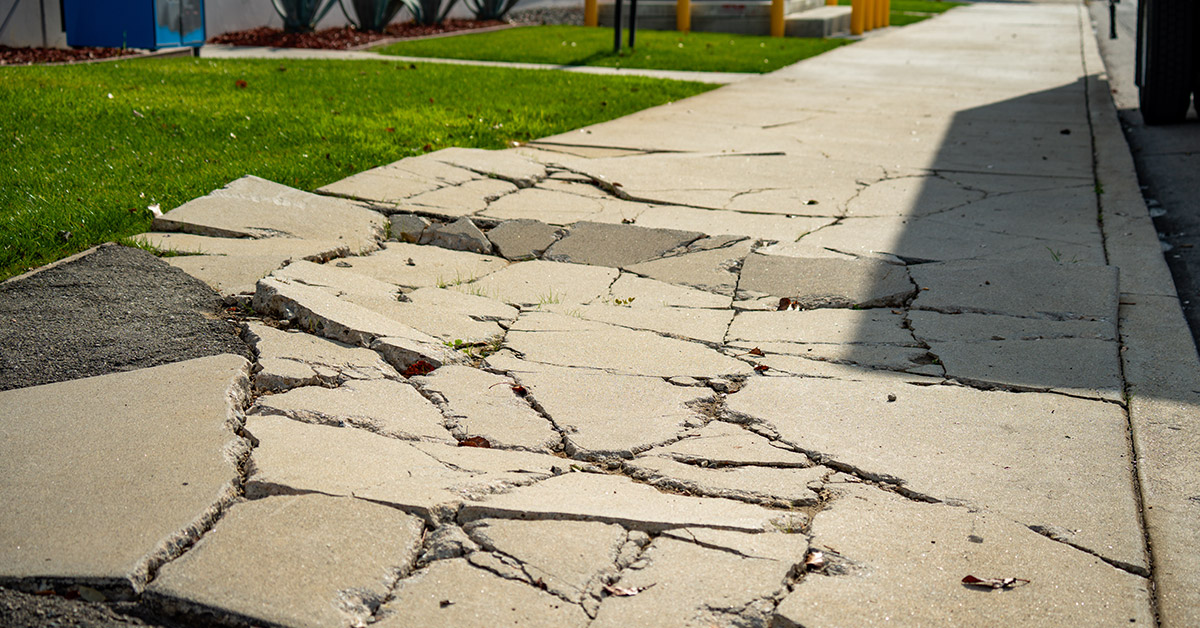
Common examples include raised concrete slabs, deep cracks, broken pavement, missing sections, holes, uneven surfaces, and deteriorated sidewalk edges.
Tree roots can sometimes push pavement upward, creating a sudden change in elevation.
Construction activity may also leave dangerous gaps or uneven surfaces.
Poor drainage can contribute to deterioration or create additional hazards.
However, not every minor irregularity is legally actionable.
Sidewalks are exposed to weather, heavy pedestrian use, and ordinary wear. The law does not require every walking surface to be perfectly level.
The seriousness of the condition, its location, visibility, duration, and effect on ordinary travel can all influence whether a claim is viable.
Photographs and measurements taken soon after the accident may help document the precise condition before it is repaired or altered.
How Do You Prove a Sidewalk Injury Claim in Massachusetts?
A successful sidewalk injury claim in Massachusetts generally requires evidence connecting the dangerous condition to the fall and establishing the responsible party’s legal liability.
The first step is documenting the location.
Photographs should show the damaged sidewalk from several angles, including the surrounding area and any nearby landmarks that help identify exactly where the accident happened.
When appropriate and safe, measurements may help demonstrate the height difference between pavement sections or the size of a hole.
Witness statements can also be valuable.
Someone who saw the fall may be able to explain how the accident occurred. Nearby residents or business owners may know how long the sidewalk had been damaged.
Previous complaints, maintenance records, inspection reports, and repair requests may help establish notice.
Medical records are equally important because they document the injuries, treatment, and relationship between the fall and the resulting physical harm.
The evidence needed will depend on whether the case involves a public-way defect, private premises liability, or negligence by another party.
For a broader discussion of property injury claims, see our article about getting injured on someone else’s property in Massachusetts.
Determining responsibility may require examining property records, municipal maintenance obligations, the location of the defect, and whether a private party created or contributed to the hazard.
Can a Business Be Responsible for a Broken Sidewalk Outside Its Entrance?
Sometimes, but not automatically.
A business may operate next to a public sidewalk without having legal responsibility for repairing every defect in that sidewalk.
However, the circumstances may change if the business created the dangerous condition, controlled the relevant area, or had another legally recognized responsibility.
For example, a business or contractor might perform work that damages a pedestrian walkway or leaves an unsafe obstruction.
A different situation arises when someone falls on a walkway located entirely within the business’s private property.
In that case, premises liability principles may apply to the party responsible for maintaining the area.
The distinction between public and private property is critical.
An injured person should not assume that the nearest business is responsible simply because the fall happened outside its front door.
Our article about injuries caused by dangerous conditions at stores in Massachusetts explains how a business’s knowledge of a hazard and its response can affect liability.
What if a Tree Root Caused the Sidewalk to Crack?
Tree roots can lift concrete slabs and create uneven walking surfaces, particularly in older neighborhoods.
These conditions may develop gradually over time.
In Boston, Cambridge, Brookline, Somerville, and other established communities, mature street trees often grow close to sidewalks and pedestrian routes.
When a root raises the pavement, the resulting height difference may create a tripping hazard.
However, identifying the tree does not automatically establish who is legally responsible.
The relevant questions may include whether the sidewalk is public or private, which entity has maintenance responsibility, how long the condition existed, and whether the defect could reasonably have been addressed.
A claim should focus on the legally responsible party and the condition of the walkway rather than assuming that the owner of a nearby tree must pay for the injury.
What if You Fell on a Sidewalk During Construction?
Construction-related sidewalk injuries may involve additional responsible parties.
A contractor may remove pavement, create an uneven temporary surface, leave debris in a pedestrian route, or fail to provide appropriate protection around an excavation.
Depending on the circumstances, the contractor, property owner, public authority, or another party may have relevant legal responsibilities.
Temporary barriers, warning signs, permits, inspection records, and photographs of the work area may become important evidence.
A claim involving a private contractor who created a dangerous condition can differ legally from a claim based solely on a municipality’s failure to repair an existing public sidewalk.
Determining how the hazard developed is therefore just as important as identifying where the fall occurred.
Can You Sue if You Were Partly Responsible for the Fall?
Potentially.
An insurance company or defendant may argue that the injured person was distracted, walking too quickly, looking at a phone, or failing to notice an obvious hazard.
These arguments do not automatically defeat every claim.
Massachusetts follows a modified comparative negligence system under Chapter 231, Section 85.
For claims governed by that statute, an injured person’s negligence generally reduces recoverable damages in proportion to their share of fault. Recovery is barred when the person’s negligence is greater than the combined negligence of the defendants against whom recovery is sought.
For example, if an injured person is found 20% responsible for an accident and the defendant 80% responsible, damages may be reduced by 20%.
However, public-way defect claims have their own statutory framework, and an attorney must evaluate how the applicable rules affect a particular case.
The central issue is what the evidence establishes, not simply whether an insurer claims the pedestrian should have been more careful.
What Injuries Can Result From a Broken Sidewalk?
A fall onto concrete or pavement can cause serious injuries.
People often instinctively extend their hands to break a fall, which can result in wrist fractures, hand injuries, or shoulder damage.
Others land on their knees, hips, or backs.
Older adults may be especially vulnerable to hip fractures and complications following a serious fall.
Head injuries can also occur when someone strikes the pavement or another hard surface.
A concussion or traumatic brain injury may require ongoing medical care, even when the injured person initially appears alert.
Some injuries are not fully apparent immediately after the accident.
Swelling, persistent pain, reduced mobility, dizziness, or other symptoms may develop or become more noticeable over time.
Seeking appropriate medical evaluation is important both for personal health and for accurately documenting the consequences of the fall.
How Much Compensation Can You Receive for a Sidewalk Injury?
There is no standard settlement amount for a sidewalk injury in Massachusetts.
Compensation depends on the responsible party, the governing law, the severity of the injury, and the available evidence.
In an ordinary negligence claim, potentially recoverable damages may include medical expenses, lost wages, reduced earning capacity, pain and suffering, and future medical needs.
However, public-way defect claims are subject to important statutory limitations.
For certain municipal public-way claims under Chapter 84, Section 15, damages are capped at $5,000.
Claims involving state-maintained ways may be subject to different statutes and limitations.
This means a person who suffers a serious injury on a public sidewalk may face a different recovery framework from someone who sustains the same injury on a privately maintained walkway.
A private contractor’s independent negligence may also present different legal questions.
An attorney can evaluate whether multiple parties or distinct legal claims are involved.
It is important not to assume that every sidewalk injury lawsuit offers the same potential compensation.
What Should You Do After Falling on a Broken Sidewalk?
Your first priority should be medical care.
If the injury is serious, seek emergency assistance rather than attempting to walk away.
If you are able to do so safely, document the condition that caused the fall.
Take photographs of the damaged pavement, the surrounding area, and any visible injuries.
Record the exact location, date, and approximate time.
If someone witnessed the accident, obtain their contact information when possible.
Preserve your shoes, medical records, receipts, and other relevant evidence.
If the sidewalk is public, promptly determine whether the incident is subject to a statutory written-notice requirement.
Reporting a hazardous sidewalk to the city may help protect other pedestrians, but an ordinary maintenance complaint should not be treated as a substitute for legally required notice of an injury claim.
Because the applicable deadline may be only 30 days, speaking with an attorney quickly can be particularly important.
Why Sidewalk Injury Cases Matter in Boston and Greater Boston
Boston and its surrounding communities contain a combination of historic neighborhoods, older sidewalks, heavy pedestrian traffic, and ongoing construction.
People regularly walk between homes, businesses, public transportation stops, medical offices, and schools.
In neighborhoods such as Beacon Hill, Back Bay, Dorchester, Jamaica Plain, and South Boston, pedestrians may encounter older pavement, tree-lined streets, and narrow walking routes.
Nearby cities and towns such as Cambridge, Somerville, Brookline, Newton, and Quincy have their own sidewalk maintenance systems and local conditions.
The location of the accident can influence which public entity or private party may be responsible.
A sidewalk maintained by the City of Boston may involve different procedures from a walkway inside a private apartment complex or a pedestrian route affected by construction.
This is why an accurate location and an early investigation are essential.
When Should You Contact a Massachusetts Sidewalk Injury Lawyer?
Consider contacting an attorney promptly if you suffered a fracture, head injury, significant mobility limitation, or another serious injury after falling on damaged pavement.
Legal guidance is particularly important when the fall occurred on a public sidewalk because statutory notice requirements may apply.
An attorney can investigate who was responsible for maintaining the walkway, whether a legally actionable defect existed, and whether the evidence supports a claim.
The investigation may also examine prior complaints, maintenance records, construction activity, witness accounts, and the full extent of the injuries.
Swartz & Swartz, P.C. represents people injured because of negligence and dangerous property conditions.
Learn more about the firm’s Boston personal injury attorneys and how they evaluate serious injury claims.
Frequently Asked Questions About Sidewalk Injuries in Massachusetts
Can I sue the city if I trip on a cracked sidewalk?
Potentially. Massachusetts law allows certain claims involving defective public ways, but the injured person must satisfy the applicable legal requirements, including notice and proof of the defect.
How long do I have to notify the city about a sidewalk injury?
For many claims governed by Massachusetts General Laws Chapter 84, Section 18, written notice must be provided within 30 days. Different rules may apply depending on the responsible party and type of claim.
Can I sue a homeowner if I fall on the sidewalk outside their house?
Not automatically. A homeowner’s property bordering a public sidewalk does not necessarily make the homeowner responsible for structural defects. Liability depends on the applicable duties and whether the homeowner created or contributed to the hazard.
Does a sidewalk have to be severely damaged to support a claim?
Not necessarily, but a minor irregularity does not automatically establish liability. The condition must satisfy the applicable legal standard, and the evidence must connect it to the injury.
What if I fell because of a raised sidewalk caused by tree roots?
You may have a claim depending on the location, maintenance responsibility, notice, and other circumstances. The nearby tree’s ownership does not alone establish liability.
Can I sue if the sidewalk was broken during construction?
Potentially. A contractor or another party may be liable if negligent construction activity created the dangerous condition. The specific legal requirements depend on who caused the hazard and the nature of the claim.
Can I recover pain and suffering after a sidewalk fall?
Potentially, but the answer depends on the governing law. Ordinary negligence claims and statutory public-way defect claims may have significantly different damages rules and limitations.
What if I did not take pictures immediately after the fall?
You may still have evidence through witnesses, medical records, nearby cameras, maintenance records, or photographs taken later. However, documenting the location as soon as reasonably possible can be helpful.
Injured on a Broken Sidewalk in Massachusetts? Understand Your Legal Options
A serious sidewalk fall can leave you dealing with medical bills, lost income, ongoing pain, and uncertainty about who should be held responsible.
A sidewalk injury in Massachusetts may support a legal claim when a dangerous condition causes harm and the applicable requirements for liability are met.
But sidewalk cases are not all governed by the same rules.
A fall on a municipal sidewalk can involve different deadlines, legal standards, and damages limitations from an injury on private property or a walkway damaged by a contractor.
Most importantly, some public-way claims require written notice within 30 days of the injury.
Waiting too long to investigate the circumstances can make it more difficult to preserve evidence and protect your legal rights.
Swartz & Swartz, P.C. represents injured individuals and families in Boston, Massachusetts, and the surrounding New England states.
If you or a loved one suffered a serious injury because of a broken or uneven sidewalk, call (617) 742-1900 to discuss your situation and learn what legal options may be available.
Need Help?
If you or someone you know, needs help from a lawyer, contact the law offices of Swartz & Swartz, use our live chat, or send us a message using the form below and we’ll get in touch to assess your case and how we can help.
About the Author: James Swartz

Keep Reading
Want more? Here are some other blog posts you might be interested in.

A sidewalk injury in Massachusetts can happen in an instant. You may be walking to work, leaving a restaurant, visiting

Inadequate security at an apartment building in Massachusetts can have devastating consequences when a preventable safety failure contributes to a

Emotional distress after a car accident in Massachusetts can be just as disruptive as a physical injury, yet it is